Guardrail Preventivi e Policy as Code per la Governance Cloud Enterprise
Preventive Guardrails and Policy as Code for Enterprise Cloud Governance
Sommario
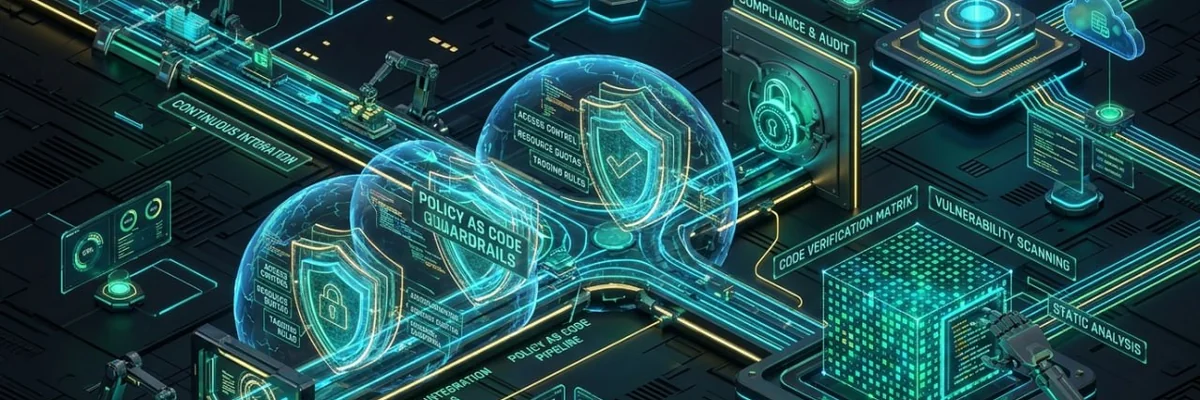
Nei grandi gruppi bancari e assicurativi, la governance del cloud non può ridursi a un processo manuale di approvazione né a verifiche retrospettive affidate ad audit trimestrali. Quando centinaia di team infrastrutturali rilasciano modifiche continue tramite pipeline CI/CD, l'unico modello sostenibile consiste nel codificare i requisiti di sicurezza e conformità come policy eseguibili. Questo articolo analizza l'architettura a tre livelli di guardrail per il cloud enterprise: controlli preventivi sul codice Terraform con Open Policy Agent (OPA), controlli detective continui a runtime e remediations reattive automatizzate per eliminare il drift normativo senza rallentare il ciclo di sviluppo.
Il gap tra le linee guida di compliance e la realtà operativa
La maggior parte delle organizzazioni definisce policy di sicurezza e conformità (Security Architecture Guidelines, standard CIS Benchmark, requisiti PCI-DSS e DORA) in corposi documenti statici. Quando queste regole devono essere tradotte in infrastruttura reale su AWS, Azure o Google Cloud, emergono criticità strutturali:
- Verifiche manuali inefficienti: I team di security review non riescono a tenere il passo con il volume di pull request e merge request generate dagli sviluppatori, trasformandosi nel principale collo di bottiglia operativo.
- Rilevamento tardivo dei rischi: Se una risorsa non conforme (es. un security group con
0.0.0.0/0aperto sulla porta SSH, o un volume EBS privo di cifratura KMS) viene rilevata solo dopo essere stata instanziata in produzione, l'azienda si trova esposta a rischi di attacco o a sanzioni degli organi di vigilanza. - Alert Fatigue e debito correttivo: Gli scanner CSPM (Cloud Security Posture Management) generano migliaia di allarmi retroattivi. I team applicativi si trovano sommersi da ticket di remediation con scadenze a breve termine, distogliendo risorse dall'evoluzione del business.
La soluzione consiste nello spostare la governance a sinistra (Shift-Left), rendendo l'infrastruttura non conforme impossibile da rilasciare.
Architettura a tre livelli di Guardrail Cloud
Una governance cloud enterprise matura adotta una strategia a cerchi concentrici basata su tre livelli complementari:
flowchart TD
    subgraph ShiftLeft["1. Guardrail Preventivi (Pre-Deployment)"]
        DevCode["Terraform / OpenTofu Code"] --> CI_CD["CI/CD Pipeline"]
        CI_CD --> Plan["terraform plan (JSON Output)"]
        Plan --> OPA["Open Policy Agent / Conftest (Rego Rules)"]
        OPA -->|Pass| Deploy["Apply in Landing Zone"]
        OPA -->|Fail (Exit 1)| Reject["Pipeline Blocked (Immediate Feedback)"]
    end

    subgraph RuntimePlane["2. Guardrail Detective (Continuous Monitoring)"]
        Deploy --> CloudAPI["Cloud Resources (AWS / GCP / Azure)"]
        CloudAPI --> Config["AWS Config / GCP Security Health Analytics"]
        Config --> ComplianceRules{"Rule Evaluation"}
        ComplianceRules -->|Non-Compliant| EventBus["Security EventBridge / PubSub"]
    end

    subgraph Remediation["3. Guardrail Reattivi (Auto-Remediation)"]
        EventBus --> StepFunction["Remediation Step Function / Lambda"]
        StepFunction --> AutoFix["Quarantine / Revoke Public Access / Encrypt"]
        StepFunction --> AuditLog["Log Immutabile (SIEM / SOAR)"]
    end
1. Guardrail Preventivi: Blocco a monte con Policy as Code
I controlli preventivi analizzano il piano di esecuzione di Terraform (terraform plan -out=tfplan.binary) trasformato in JSON prima che qualsiasi risorsa venga creata nel cloud provider.
Se una risorsa viola le regole architetturali aziendali, la pipeline CI/CD fallisce istantaneamente, fornendo allo sviluppatore il motivo esatto del blocco direttamente nel log di build o nella pull request.
Esempio di Policy OPA Rego per l'enforcement della cifratura e dei tag FinOps
Il codice Rego seguente verifica due requisiti inderogabili per gli ambienti di produzione bancari: ogni bucket S3 o database RDS deve specificare una chiave KMS Customer Managed Key (CMK) autorizzata e deve contenere i tag obbligatori di CostCenter e DataClassification:
package terraform.banking.governance

import future.keywords.in

default allow = false

# Campi di tagging obbligatori per conformità FinOps e Data Protection
mandatory_tags := ["CostCenter", "DataClassification", "Environment", "Owner"]

# Lista delle chiavi KMS autorizzate dell'organizzazione
authorized_kms_prefix := "arn:aws:kms:eu-south-1:123456789012:key/"

# Valuta se tutte le risorse conformano alle regole
allow {
    count(violations) == 0
}

# Regola 1: Verifica presenza dei tag obbligatori su tutte le risorse taggabili
violations[msg] {
    resource := input.resource_changes[_]
    resource.mode == "managed"
    resource.change.actions[_] in ["create", "update"]

    # Risorse che supportano il tagging
    startswith(resource.type, "aws_")

    tags := object.get(resource.change.after, "tags", {})
    missing := [tag | tag := mandatory_tags[_]; not tags[tag]]
    count(missing) > 0

    msg := sprintf("Risorsa '%v' rifiutata: mancano i seguenti tag obbligatori: %v", [resource.address, missing])
}

# Regola 2: Forza la cifratura dei volumi EBS con KMS CMK dedicato
violations[msg] {
    resource := input.resource_changes[_]
    resource.type == "aws_ebs_volume"
    resource.change.actions[_] in ["create", "update"]

    not resource.change.after.encrypted == true
    msg := sprintf("Volume EBS '%v' non conforme: la cifratura deve essere attiva.", [resource.address])
}

violations[msg] {
    resource := input.resource_changes[_]
    resource.type == "aws_ebs_volume"
    resource.change.actions[_] in ["create", "update"]

    kms_key := object.get(resource.change.after, "kms_key_id", "")
    not startswith(kms_key, authorized_kms_prefix)

    msg := sprintf("Volume EBS '%v' rifiutato: deve utilizzare una chiave KMS del pool bancario autorizzato (trovata: '%v').", [resource.address, kms_key])
}
Integrando questa verifica con conftest test tfplan.json -p policies/, la conformità viene validata in meno di 2 secondi all'interno della pipeline, azzerando le violazioni che raggiungono gli ambienti runtime.
2. Guardrail Detective: Rilevamento continuo del drift
Anche con controlli preventivi in CI/CD, possono verificarsi drift configurativi dovuti a procedure break-glass di emergenza, modifiche via console da parte di account privilegiati o aggiornamenti delle API dei provider.
I servizi di monitoraggio continuo della configurazione (come AWS Config, Azure Policy in modalità audit o Google Cloud Security Command Center) eseguono valutazioni periodiche e su base evento per rilevare discordanze tra lo stato registrato e la baseline approvata.
3. Guardrail Reattivi: Auto-Remediation deterministica
Per violazioni ad alto rischio (es. apertura accidentale di un bucket storage all'accesso pubblico o revoca dell'MFA su un utente IAM locale), il tempo di risposta umano è inaccettabile. L'auto-remediation automatizza la correzione entro pochi secondi:
- AWS Config o Security Hub emette un evento di non-conformità su Amazon EventBridge.
- Una regola EventBridge invoca una AWS Step Function o una funzione Lambda dedicata.
- La funzione applica la remediation minima (es. abilita
BlockPublicAccesssul bucket o isola l'istanza EC2 revocando i security group di rete). - Viene registrato un evento di audit strutturato nel SIEM centralizzato per consentire l'indagine di sicurezza.
Metriche di Governance e riduzione dell'Alert Fatigue
L'implementazione del framework a tre livelli produce benefici misurabili nelle metriche di piattaforma:
- Riduzione delle vulnerabilità a runtime: Il tasso di violazioni di conformità rilevate a runtime negli ambienti di produzione si riduce di oltre il 92% entro 6 mesi dall'introduzione di OPA nelle pipeline CI/CD.
- Mean Time to Remediate (MTTR): Per le violazioni critiche coperte da auto-remediation, il tempo medio di contenimento scende da 4 ore (con gestione a ticket manuale) a meno di 15 secondi.
- Soddisfazione dei team di sviluppo (DevEx): Gli ingegneri ricevono feedback immediato e deterministico sul proprio codice durante la fase di sviluppo, eliminando il frustrante rimpallo di ticket con il team di sicurezza a pochi giorni dalla data di rilascio pianificata.
Conclusione
La Cloud Governance moderna non è un insieme di divieti burocratici, ma un abilitatore di velocità e qualità ingegneristica. Per un Cloud Architect enterprise, la Policy as Code con Open Policy Agent e guardrail reattivi rappresenta l'unico meccanismo capace di conciliare l'autonomia dei team applicativi con i rigorosi requisiti di sicurezza e tracciabilità imposti dai regolatori finanziari.
Costruendo un perimetro in cui le configurazioni non conformi non possono tecnicamente essere applicate, la conformità normativa cessa di essere un costo periodico e diventa un pilastro automatico dell'infrastruttura.
Summary
In large banking and insurance groups, cloud governance cannot be reduced to a manual approval process or retrospective checks relying on quarterly audits. When hundreds of infrastructure teams release continuous changes via CI/CD pipelines, the only sustainable model is to codify security and compliance requirements as executable policies. This article analyzes a three-tier guardrail architecture for enterprise cloud: preventive controls on Terraform code with Open Policy Agent (OPA), continuous detective controls at runtime, and automated reactive remediations to eliminate compliance drift without slowing down the development cycle.
The gap between compliance guidelines and operational reality
Most organizations define security and compliance policies (Security Architecture Guidelines, CIS Benchmark standards, PCI-DSS and DORA requirements) in lengthy static documents. When these rules need to be translated into real infrastructure on AWS, Azure, or Google Cloud, structural criticalities emerge:
- Inefficient manual checks: Security review teams cannot keep up with the volume of pull requests and merge requests generated by developers, becoming the primary operational bottleneck.
- Late risk detection: If a non-compliant resource (e.g., a security group with
0.0.0.0/0open on the SSH port, or an EBS volume lacking KMS encryption) is detected only after being instantiated in production, the company is exposed to attack risks or regulatory penalties. - Alert Fatigue and remediation debt: CSPM (Cloud Security Posture Management) scanners generate thousands of retroactive alerts. Application teams are overwhelmed with remediation tickets with short deadlines, diverting resources from business evolution.
The solution involves shifting governance left (Shift-Left), making non-compliant infrastructure impossible to release.
Three-Tier Cloud Guardrail Architecture
A mature enterprise cloud governance adopts a concentric circle strategy based on three complementary tiers:
flowchart TD
    subgraph ShiftLeft["1. Preventive Guardrails (Pre-Deployment)"]
        DevCode["Terraform / OpenTofu Code"] --> CI_CD["CI/CD Pipeline"]
        CI_CD --> Plan["terraform plan (JSON Output)"]
        Plan --> OPA["Open Policy Agent / Conftest (Rego Rules)"]
        OPA -->|Pass| Deploy["Apply in Landing Zone"]
        OPA -->|Fail (Exit 1)| Reject["Pipeline Blocked (Immediate Feedback)"]
    end

    subgraph RuntimePlane["2. Detective Guardrails (Continuous Monitoring)"]
        Deploy --> CloudAPI["Cloud Resources (AWS / GCP / Azure)"]
        CloudAPI --> Config["AWS Config / GCP Security Health Analytics"]
        Config --> ComplianceRules{"Rule Evaluation"}
        ComplianceRules -->|Non-Compliant| EventBus["Security EventBridge / PubSub"]
    end

    subgraph Remediation["3. Reactive Guardrails (Auto-Remediation)"]
        EventBus --> StepFunction["Remediation Step Function / Lambda"]
        StepFunction --> AutoFix["Quarantine / Revoke Public Access / Encrypt"]
        StepFunction --> AuditLog["Immutable Log (SIEM / SOAR)"]
    end
1. Preventive Guardrails: Upstream Blocking with Policy as Code
Preventive controls analyze the Terraform execution plan (terraform plan -out=tfplan.binary) transformed into JSON before any resource is created in the cloud provider.
If a resource violates corporate architectural rules, the CI/CD pipeline fails instantly, providing the developer with the exact reason for the block directly in the build log or pull request.
Example OPA Rego Policy for Encryption and FinOps Tag Enforcement
The following Rego code verifies two essential requirements for banking production environments: every S3 bucket or RDS database must specify an authorized Customer Managed Key (CMK) KMS key and must contain the mandatory CostCenter and DataClassification tags:
package terraform.banking.governance

import future.keywords.in

default allow = false

# Mandatory tagging fields for FinOps and Data Protection compliance
mandatory_tags := ["CostCenter", "DataClassification", "Environment", "Owner"]

# List of authorized organizational KMS keys
authorized_kms_prefix := "arn:aws:kms:eu-south-1:123456789012:key/"

# Evaluate if all resources conform to the rules
allow {
    count(violations) == 0
}

# Rule 1: Check for mandatory tags on all taggable resources
violations[msg] {
    resource := input.resource_changes[_]
    resource.mode == "managed"
    resource.change.actions[_] in ["create", "update"]

    # Resources that support tagging
    startswith(resource.type, "aws_")

    tags := object.get(resource.change.after, "tags", {})
    missing := [tag | tag := mandatory_tags[_]; not tags[tag]]
    count(missing) > 0

    msg := sprintf("Resource '%v' rejected: missing the following mandatory tags: %v", [resource.address, missing])
}

# Rule 2: Enforce EBS volume encryption with dedicated KMS CMK
violations[msg] {
    resource := input.resource_changes[_]
    resource.type == "aws_ebs_volume"
    resource.change.actions[_] in ["create", "update"]

    not resource.change.after.encrypted == true
    msg := sprintf("EBS Volume '%v' non-compliant: encryption must be active.", [resource.address])
}

violations[msg] {
    resource := input.resource_changes[_]
    resource.type == "aws_ebs_volume"
    resource.change.actions[_] in ["create", "update"]

    kms_key := object.get(resource.change.after, "kms_key_id", "")
    not startswith(kms_key, authorized_kms_prefix)

    msg := sprintf("EBS Volume '%v' rejected: must use a KMS key from the authorized banking pool (found: '%v').", [resource.address, kms_key])
}
By integrating this check with conftest test tfplan.json -p policies/, compliance is validated in less than 2 seconds within the pipeline, eliminating violations from reaching runtime environments.
2. Detective Guardrails: Continuous Drift Detection
Even with preventive controls in CI/CD, configuration drifts can occur due to emergency break-glass procedures, console modifications by privileged accounts, or provider API updates.
Continuous configuration monitoring services (such as AWS Config, Azure Policy in audit mode, or Google Cloud Security Command Center) perform periodic and event-driven evaluations to detect discrepancies between the recorded state and the approved baseline.
3. Reactive Guardrails: Deterministic Auto-Remediation
For high-risk violations (e.g., accidental opening of a storage bucket to public access or MFA revocation on a local IAM user), human response time is unacceptable. Auto-remediation automates correction within seconds:
- AWS Config or Security Hub emits a non-compliance event to Amazon EventBridge.
- An EventBridge rule invokes a dedicated AWS Step Function or Lambda function.
- The function applies the minimal remediation (e.g., enables
BlockPublicAccesson the bucket or isolates the EC2 instance by revoking network security groups). - A structured audit event is logged in the centralized SIEM to enable security investigation.
Governance Metrics and Reduction of Alert Fatigue
Implementing the three-tier framework yields measurable benefits in platform metrics:
- Reduced runtime vulnerabilities: The rate of compliance violations detected at runtime in production environments decreases by over 92% within 6 months of OPA's introduction into CI/CD pipelines.
- Mean Time to Remediate (MTTR): For critical violations covered by auto-remediation, the average containment time drops from 4 hours (with manual ticket management) to less than 15 seconds.
- Developer Experience (DevEx) satisfaction: Engineers receive immediate and deterministic feedback on their code during the development phase, eliminating frustrating ticket back-and-forths with the security team just days before the planned release date.
Conclusion
Modern Cloud Governance is not a set of bureaucratic prohibitions, but an enabler of engineering speed and quality. For an enterprise Cloud Architect, Policy as Code with Open Policy Agent and reactive guardrails represents the only mechanism capable of reconciling application teams' autonomy with the stringent security and traceability requirements imposed by financial regulators.
By building a perimeter where non-compliant configurations technically cannot be applied, regulatory compliance ceases to be a periodic cost and becomes an automatic pillar of the infrastructure.